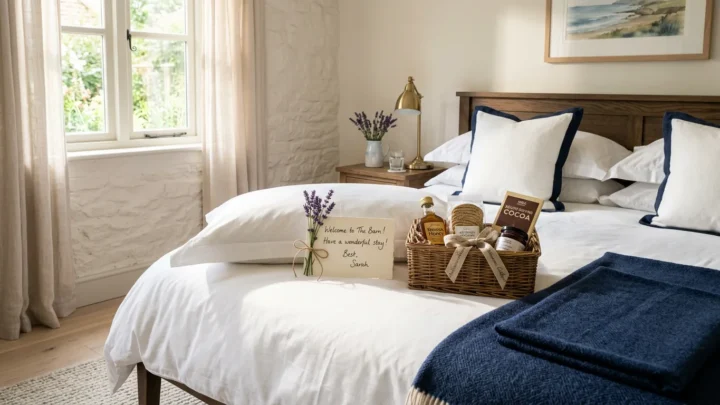
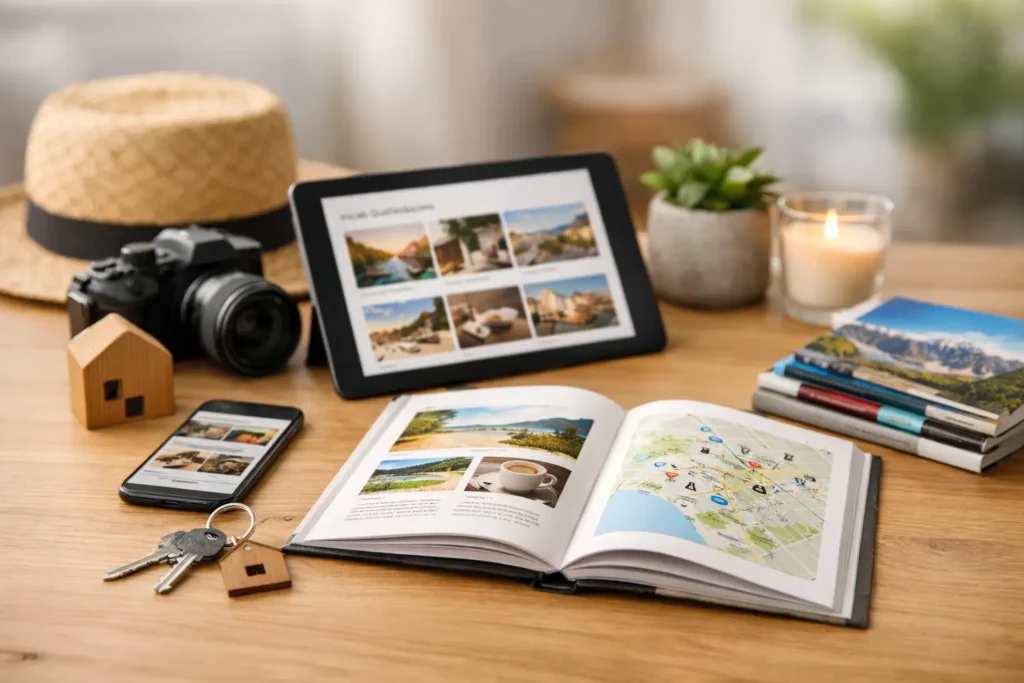
Clear guest information is specific. The examples below are starting points, not instructions for a real property. Replace every bracketed detail and check each statement before sharing.
In this guide
Adapt examples without copying the details
Example properties and sample instructions are starting points. Replace times, entrance descriptions, parking arrangements, contact details and appliance steps with your own verified information. A city apartment might need intercom instructions; a rural cottage might need an accurate map pin and a landmark. Read every card at the property before letting guests rely on it.
What the best Airbnb guidebook examples have in common
Strong Airbnb guidebook examples tend to follow the same basic principle: they put the right information in the right order. Guests do not read guidebooks from top to bottom like a brochure. They jump to whatever they need in the moment, often while standing outside the property, carrying bags, with limited patience.
That means your guide has to work in real life, not just in theory. Check-in instructions should be clearer than your local restaurant tips. Parking should be easier to find than your backstory as a host. House rules should be direct, but not cold.
The best examples are also specific. “Parking available nearby” is weak. “Use bay 14 behind the building. Do not park in visitor spaces” is useful. The difference is not style. It is whether the information helps someone avoid a problem.
1. The quick-start arrival guide
This is the most practical of all Airbnb guidebook examples because it solves the most stressful part of the stay. A quick-start arrival guide focuses on the first 30 minutes after guests arrive.
It usually includes the full property address, where to park, how to enter, where to find the keys if needed, the Wi-Fi details, and what to do if something does not work. If your property has a lockbox, gate, shared entrance or hard-to-spot front door, this section matters even more.
A common mistake is trying to make arrival instructions too polished. Guests do not need elegant copy here. They need clarity. Short steps, plain wording, and ideally photos where confusion is likely.
2. The room-by-room house manual
Some properties need more than a basic overview, especially older cottages, larger homes, or places with a few quirks. A room-by-room guidebook works well when guests may need help using appliances, adjusting heating, finding spare bedding, or working out which light switch does what.
This format is especially useful for family stays and longer bookings. It cuts down on the small messages that pile up over a weekend, like how to turn on the oven or where the ironing board is kept.
The trade-off is length. If you include every possible detail, guests may ignore the whole thing. Keep it practical. Only include instructions for things that are not obvious, easy to misuse, or likely to generate questions.
3. The house rules guide that does not sound hostile
Many hosts struggle with this part. They want to protect the property, but they do not want to sound like they expect trouble. Good house rules guidebook examples strike that balance by explaining expectations clearly, without filling the page with warnings.
This type of guide usually covers smoking, pets, quiet hours, extra guests, rubbish, and checkout basics. The strongest version keeps the tone calm and matter-of-fact. “Please keep noise low after 10pm to respect neighbours” works better than writing in capital letters about complaints.
If you manage a flat, a terrace, or any property with close neighbours, this section deserves real attention. It can prevent poor reviews just as much as it prevents damage.
4. The local area guide guests actually use
Hosts often enjoy writing this section the most, but it works best when it stays focused. Guests do not need a long list of every café and pub within ten miles. They need a shortlist that helps them decide quickly.
Useful local guidebook examples usually group recommendations by purpose. Where should guests go for breakfast? Which pub is best for a Sunday roast? Where is the nearest supermarket? What is walkable, and what needs a car?
This is also where local knowledge can make your guide feel more valuable than a generic listing description. If a beach car park fills up by 9am, say so. If a nearby footpath gets muddy after rain, mention it. Those details are what guests remember.
5. The family-friendly guidebook
If your property attracts families, your guidebook should reflect that. Family-focused Airbnb guidebook examples include the practical details parents look for straight away: cot availability, stair gates, high chairs, bath setup, safe outdoor space, and nearby activities that work for children.
This format is not about calling the property family-friendly and leaving it there. It is about reducing uncertainty. Parents want to know whether the garden is enclosed, whether there are plastic plates in the kitchen, and whether the nearest shop is close enough for forgotten essentials.
A family guide can also help manage expectations. If your cottage has steep stairs or a wood burner, say so plainly. The right guest will appreciate the honesty.
6. The pet-friendly guidebook
Pet-friendly stays can benefit from a dedicated section rather than one line in the house rules. Guests travelling with dogs in particular tend to have very specific questions, and if you answer them early, the stay feels easier from the start.
A strong pet guide includes where dogs can be walked nearby, whether the garden is secure, what furniture rules apply, where muddy paws should be cleaned, and whether there are any restrictions on leaving pets alone in the property.
This is one of those it-depends areas. If your property is only loosely pet-friendly, keep the wording precise so guests do not make assumptions. If it is genuinely set up for dog owners, a well-written guide section can become a booking advantage.
7. The serviced accommodation operations guide
For serviced accommodation, especially properties used by contractors, corporate guests or repeat short-stay travellers, the guidebook often needs to be more functional than warm. That is not a bad thing. It simply means the priority is speed and consistency.
This type of guidebook focuses on reliable access to essentials: check-in, parking, Wi-Fi, heating, appliance use, waste collection, and checkout. It may also include invoice-related notes, emergency contacts, and clear troubleshooting for common issues.
The best examples here are stripped back. Guests staying for work usually do not need a long welcome message or six pages of local recommendations. They need the information that keeps the stay running smoothly.
8. The premium stay guidebook
Higher-end properties often need a slightly different approach. Guests may expect a more polished experience, but they still need the same practical information. A premium guidebook combines clear instructions with a stronger sense of presentation.
That might mean better photography, more curated local recommendations, and more attention to detail in the language. It can also include information about extras such as hot tubs, coffee machines, concierge-style touches, or local dining worth booking in advance.
The risk here is over-designing the guide and under-explaining the basics. Even in a premium stay, guests will still want to know how to get in, how to work the heating, and what to do at checkout.
9. The digital-first QR code guidebook
This is increasingly the format hosts prefer because it matches how guests already behave. Instead of looking for a printed folder in the kitchen drawer, they scan a code or open a link and get everything on their mobile phone.
Digital-first Airbnb guidebook examples work well because they are easier to update, easier to share before arrival, and much easier to keep consistent across multiple properties. If you change the Wi-Fi password, replace a coffee machine, or update your checkout steps, you can fix it once instead of reprinting pages.
They also reduce clutter in the property. For hosts managing more than one listing, that matters. A digital guidebook keeps information centralised and easier to maintain, especially when guests book through different channels.
How to choose the right guidebook style
The right format depends on the property and the type of guest you attract. A city-centre flat for weekend breaks may need a fast, minimal guide focused on access and local recommendations. A rural holiday cottage may need more detail on heating, directions, bins, and appliance use.
If you manage several properties, consistency matters as much as content. Guests should know where to find key details, even if the homes are different. This is where a simple digital structure helps. You can keep the same layout across every property while customising the details that matter.
It is also worth checking which questions you answer most often in messages. Those repeat questions are your guidebook brief. Build around them first, then add the extras.
What to include first if you are starting from scratch
If your current guidebook is a mix of old notes, printed sheets and saved message templates, start small. Begin with the information guests need most urgently: check-in steps, Wi-Fi, parking, heating, house rules, and checkout. Then add appliance help and local recommendations once the essentials are solid.
That approach usually works better than trying to write the perfect guidebook in one sitting. Guests care more about finding the key safe than reading a polished introduction.
For many hosts, the simplest setup is a mobile-friendly digital guide they can update in minutes and share by link or QR code. That is exactly why tools like Welcomly exist. Not to make guidebooks flashy, but to make guest information easier to manage and easier to use.
A good guidebook should feel almost invisible during a stay. Guests find what they need, problems are avoided, and you spend less time repeating yourself. That is usually the clearest sign you have built the right one.
Want a shortcut for the Wi-Fi example? Our free Wi-Fi QR code generator turns your network name and password into a printable QR card.
Put this into practice in minutes.
Free to build. 30 days free when you publish. £4.99 a month after that.